Getting to Know the Advantages and Disadvantages of Floating Solar Power Plants in Indonesia
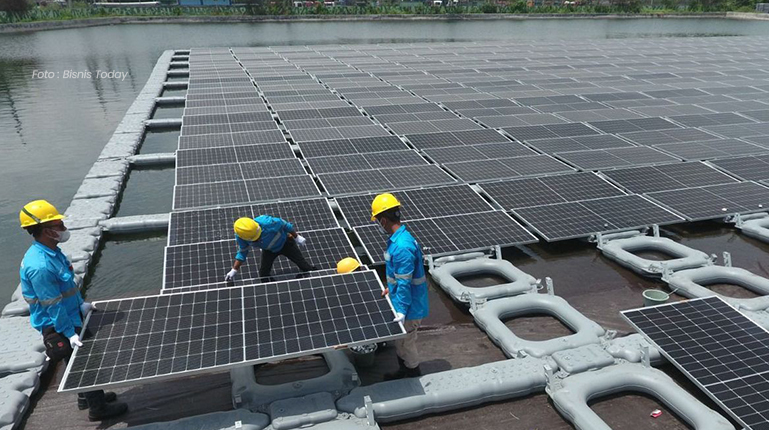
Floating photovoltaic power plants (PLTS) are an innovative solution that is currently growing rapidly in Indonesia as an alternative to environmentally friendly power plants.
Analysis by the Institute for Essentials Services Reform (IESR) states that the potential for floating PLTS in Indonesia reaches 28.4 Gigawatts (GW). This potential is spread across 783 reservoirs and lakes, each of which has a minimum potential of 1 Megawatt (MW).
It is no wonder that the government is targeting to build 60 floating PLTS in Indonesia while simultaneously pushing the target of a power plant mix from EBT of 23 percent by 2025.
In terms of construction, the installation of floating photovoltaics is equipped with hollow plastic buoys that are designed to withstand extreme weather conditions and the potential for disruption to cables connected to electrical installations on land.
However, because of its character which is installed in water, floating PLTS also has negative impacts. Here are the advantages and disadvantages of floating PLTS (floating photovoltaics).
Advantages of Floating Solar Power Plants
- Space Utilization
By utilizing the water surface, floating solar power plants save land that is usually used for agriculture, settlements, or industry. This is very relevant in Indonesia, where large land areas are often difficult to obtain for large-scale energy projects.
- Increase Solar Panel Efficiency
Water has a natural cooling effect that can lower the temperature of solar panels. This lower temperature helps increase panel efficiency, as solar panels are more efficient at lower temperatures.
- Reduce Water Evaporation
Panels floating on reservoirs or lakes can reduce the rate of water evaporation, which is beneficial for areas prone to drought. This can be a major advantage for water management in Indonesia, especially in areas with long dry seasons.
- Minimize the Impact on Land Ecosystems
Because floating solar power plants are placed in water, this development will not disturb habitats or convert land areas, which are important in maintaining biodiversity in land ecosystems.
- Renewable and Clean Energy Source
Like solar power plants in general, floating solar power plants do not produce greenhouse gas emissions or air pollution. This contributes to Indonesia's target of reducing carbon emissions and achieving cleaner energy.
Disadvantages of Floating Solar Power Plants
- Higher Installation Costs
Additional infrastructure and components, such as buoys, anchors, and waterproof electrical systems, increase the installation costs of floating solar power plants compared to conventional solar power plants on land.
- More Complicated Maintenance
Floating solar power plants require more complicated maintenance due to the higher risk of corrosion in wet environments and difficult access. Waterproof equipment also requires more costs and more specialized maintenance procedures.
- Impact on Aquatic Ecology
Shades from solar panels and the presence of structures above the water can reduce sunlight entering the water, which may disrupt aquatic ecosystems, especially in terms of photosynthesis of aquatic plants.
- Vulnerable to Weather and Nature
Extreme weather such as strong winds, waves, or earthquakes can damage floating PV installations. The system must be designed very robustly to withstand Indonesia's diverse weather, especially during the rainy season or in areas prone to earthquakes.
- Potential Disturbance to Water Activities
Reservoirs and lakes are often used for other activities, such as irrigation, fisheries, or tourism. Floating PV can reduce the area that can be used for these activities or interfere with fishing boat routes.
Floating PV offers great potential as a renewable energy solution in Indonesia, especially to optimize the use of space and preserve water resources.
Realistically, however, floating PV is unlikely to replace large-scale power plants or the increasing trend of onshore PV anytime soon. But it is very possible that they can fill an important complementary role, adding capacity that is currently lacking.
Let's move towards renewable energy with SEI!


Berita Lainnya


 Contact Us: